

Spend five minutes reading marketing advice and you will come away with a list of twelve things your business should be doing simultaneously. Start a podcast. Post on LinkedIn daily. Run Google Ads. Build an email list. Produce YouTube videos. Publish two blogs a week. irely wrong. The problem is that it is written without any sense of what a small business has the capacity to execute. Doing all of it poorly produces less than doing two things very well.
Every business has a finite amount of time, budget, and attention to allocate across marketing. Global digital ad spending is projected to exceed $870 billion by 2027. Brands that combine owned, earned, and paid channels thoughtfully report the highest marketing ROI over time. That combination piece is what most businesses skip when they jump straight into execution without a framework for what each channel is supposed to do.
This blog explains the owned, earned, and paid framework that underpins all digital marketing channel strategy, walks through each major channel, and gives you a practical way to decide which combination fits your business rather than defaulting to whatever is currently trending.
Owned, Earned, and Paid Media: The Core Framework
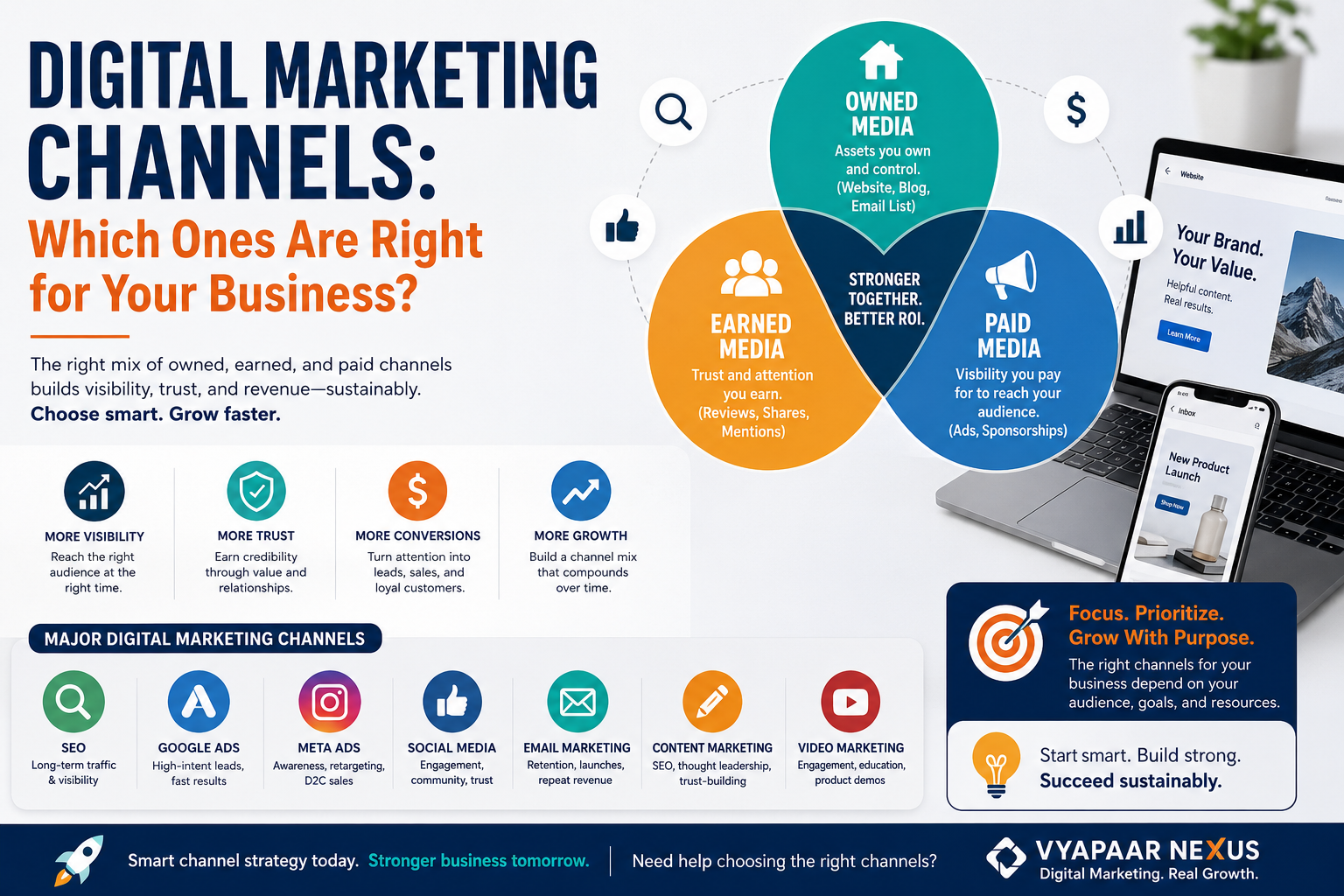
Every digital marketing channel belongs to one of three categories. Each has a different cost structure, level of control, and timeline for results. Getting this framework clear makes channel selection considerably more direct.
1, Owned Media
Owned media includes any digital asset you control entirely: your website, blog, email list, and app. It forms the foundation of any durable digital marketing channel strategy because it stays under your control regardless of what any platform does with its algorithm. Your website keeps generating traffic whether or not Instagram reduces organic reach next quarter. Your email list remains yours regardless of feed changes on any social platform. Content marketing built on owned channels costs 62% less than traditional marketing while generating three times as many leads.
2, Earned Media
Earned media is attention received because your content or service warranted it, rather than because you paid for placement. Organic search rankings, customer reviews, social shares, and press coverage all fall here. It carries the highest credibility because it originates from third parties. Research consistently shows that 85% of consumers trust online reviews as much as personal recommendations, which is why earned visibility produces stronger conversion outcomes than paid placement alone.
3, Paid Media
Paid media covers every channel where you pay for visibility: Google Ads, Meta Ads, display advertising, programmatic campaigns, and sponsored placements. It offers immediacy and targeting precision that organic channels cannot match. A campaign reaching a specific demographic in a defined city can go live within hours of a brief being finalised. Paid digital marketing channels are the fastest route to visibility for new businesses or new product launches where organic presence has not yet been established.
Major Digital Marketing Channels at a Glance
Channel | Media Type | Best Use Case | Time to Results |
SEO | Owned + Earned | Long-term organic traffic, local search | 3-6 months |
Google Ads (PPC) | Paid | High-intent search capture, fast leads | Days to weeks |
Meta Ads (FB/IG) | Paid | Brand awareness, retargeting, D2C sales | Days to weeks |
Social Media (Organic) | Owned + Earned | Brand trust, community, engagement | 3-6 months |
Email Marketing | Owned | Retention, launches, repeat revenue | Immediate |
Content Marketing | Owned + Earned | SEO, thought leadership, trust-building | 6-12 months |
Video Marketing | Owned + Earned | Engagement, education, product demos | 3-6 months |
Breaking Down Each Channel
1, Search Engine Optimisation
SEO earns visibility through content quality, technical site health, and links from other credible sources. Research consistently shows that 68% of all online experiences begin with a search engine, and the first organic result earns a click-through rate of 31.7% on average. As a digital marketing channel, SEO is slow to build but produces compounding, sustainable traffic. A well-ranked page published today continues delivering qualified visitors for years without additional cost per click.
2, Paid Search
Paid search delivers visibility within hours of a campaign going live. You bid on keywords and pay per click, with the average Google search network CPC sitting around $5.26 across industries. It is the most effective online marketing channel for capturing users actively searching for what you sell, particularly for transactional queries where the user is close to a decision. The fastest-returning channel in most marketing mixes when targeting and landing pages are aligned.
3, Social Media Marketing
Social media spans all three media categories simultaneously. Organic posts are owned media. Shares and mentions from your audience are earned media. Paid social campaigns are paid media. Platform selection should follow your audience: Instagram and TikTok for consumer brands targeting younger demographics, Facebook for broader age groups, LinkedIn for B2B service businesses. A social media channel strategy that follows the audience rather than the trend consistently outperforms one based on platform popularity.
4, Email Marketing
Email delivers $36 to $40 return for every dollar spent, a figure that has held consistently across industry research for years. Industry data shows 59% of consumers say email influences their purchasing decisions. The primary asset is the list itself, which you own entirely and which no platform can alter or remove. For customer retention, promotional campaigns, and product launches, email produces results that other digital marketing channels struggle to match at comparable cost.
5, Content Marketing
Content marketing creates value through blogs, videos, guides, and infographics that attract and educate potential customers over time. It fuels SEO rankings, provides material for social distribution, and supports email campaigns with relevant substance. Companies with a consistent content strategy see 7.8 times higher year-over-year organic traffic growth than those without. Content is the underlying asset that strengthens every other channel it feeds into.
How to Choose the Right Channels for Your Business
Channel selection should follow your audience and your goals rather than industry trends. Three questions worth working through before committing to any digital marketing channel:
A sensible starting point for most small businesses: build owned channels first, invest in earning organic visibility through SEO and reviews, and layer in paid channels once you have a better sense of what your audience responds to. That sequencing produces a more durable return than starting with paid and building nothing underneath it.
If you are working out which digital marketing channels deserve your budget and which can wait, Vyapaar Nexus can map out a focused channel strategy based on your audience, industry, and the growth stage your business is at.