

Walk into any conversation about search marketing and the terminology gets slippery fast. SEM and SEO are sometimes used interchangeably. Other times SEM is described as strictly the paid side of search, distinct from organic. Both definitions exist in active circulation, and neither is entirely wrong. The more useful focus is understanding what the two distinct mechanisms behind search visibility are, how they differ in cost, timeline, and strategic role, and how they complement each other when used as part of a coordinated strategy.
Search dominates the global digital advertising market, accounting for 40.9% of all digital ad spend. Search advertising spend is projected to reach $351.55 billion in 2026. Industry surveys show 80% of companies currently use Google Ads for pay-per-click campaigns. Whether competing through organic search, paid search, or a combination of both, businesses are all competing for the same real estate on the same results page, using fundamentally different tools to get there.
This blog covers what SEM marketing is, how paid search and SEO differ across four key dimensions, what the core components of an effective paid search campaign are, and how to decide which approach fits your business situation today.
What SEM Marketing Is
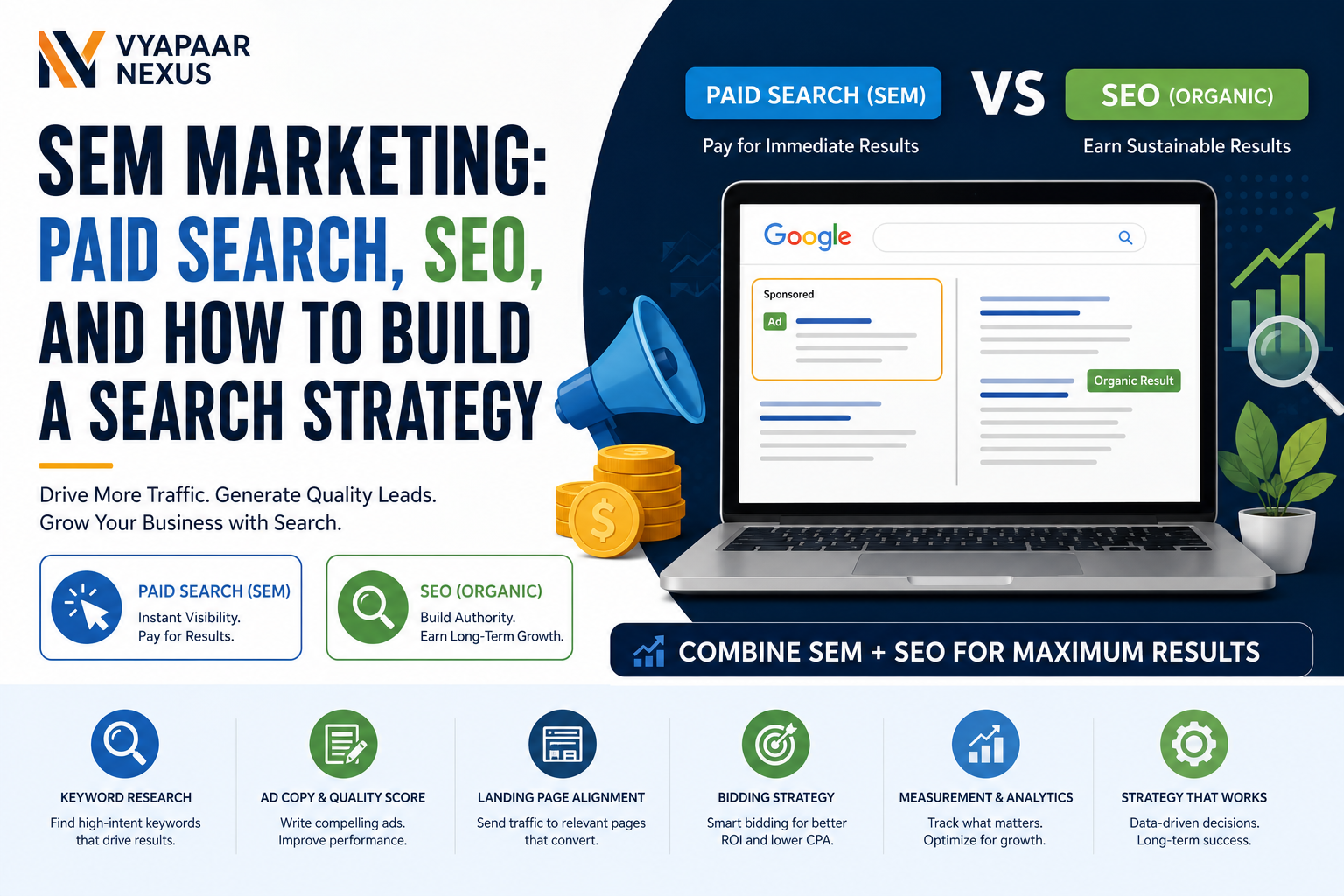
Search engine marketing is the umbrella term for all strategies used to achieve visibility in search engine results pages, spanning both organic and paid approaches. SEO is one component of SEM. Paid search advertising through platforms like Google Ads is another. When both are coordinated under a unified strategy, that is search engine marketing operating at its full scope.
The narrower, more common usage of SEM refers specifically to paid search: bidding on keywords through Google Ads or Microsoft Advertising and paying each time a user clicks your ad. Knowing both definitions is useful because organic and paid search have different mechanics, different cost structures, and different strategic roles that are designed to complement each other rather than duplicate the same function.
Paid Search vs SEO: Key Differences
Dimension | SEO (Organic Search) | Paid Search (SEM/PPC) |
|---|---|---|
How it works | Earns rankings through content quality, authority and technical health | Buys visibility through keyword bidding in Google Ads auction |
Cost structure | Investment in content and optimisation; free per click once ranked | Ongoing ad spend required; traffic stops when budget stops |
Time to results | 3-6 months for meaningful rankings | Hours to days from campaign launch |
Trust signals | Higher trust; organic results perceived as more credible | Lower trust among users who identify paid results |
1, The Mechanism
SEO earns visibility by demonstrating relevance and authority to Google's algorithm through content quality, technical site health, and links from other credible sources. This process takes time. Paid search buys visibility through an auction system where you define which keywords trigger your ads, who you want to reach, and what you are willing to pay per click. Results appear within hours of a campaign going live rather than waiting months for organic authority to develop.
2, The Cost Structure
SEO requires investment in content production, technical work, and link building over time. Once pages rank well, each additional visit arrives without a per-click cost attached. Paid search requires ongoing budget, and every click costs money. Organic and paid search together account for 80% of all trackable website visits, with organic driving 53% and paid driving 27%, reflecting the different scales at which each typically operates across most industries.
3, Timeline and Compounding Returns
Paid search delivers visibility within hours of a campaign launching. SEO delivers visibility three to six months after work begins, with returns compounding over time thereafter. This timing difference is the core reason most effective search strategies run both channels simultaneously: paid search drives results in the short term while SEO builds the foundation that reduces long-term dependence on paid spend as organic rankings strengthen.
4, Trust and Click Behaviour
Searchers place higher trust in organic listings than in paid ads among those who can identify the difference. At the same time, paid ads perform exceptionally well for transactional queries where users are close to a purchasing decision. The first organic position earns an average click-through rate of 31.7%. The top paid position varies considerably based on query type, competition level, and ad quality score.
How to Run Effective Paid Search Campaigns
1, Keyword Research for PPC
Paid search keyword research differs from SEO keyword research in one critical dimension: cost per click carries as much weight as search volume when selecting target keywords. Some high-volume keywords are prohibitively expensive in competitive sectors. The most expensive keyword category in Google Ads is insurance, at over $54 per click on average. Effective paid search strategy identifies keywords at the intersection of strong buying intent and manageable cost for your specific industry and budget.
2, Ad Copy and Quality Score
Google evaluates not just how much you bid but how relevant your ad and its destination page are to the keyword being searched. This quality score affects both your ad's position in results and your actual cost per click. A well-written, highly relevant ad pays less per click and ranks higher in results than a generic ad from a higher bidder. Ad copy that specifically matches search intent, states a clear value proposition, and leads to a relevant landing page consistently outperforms broad, generic copy in both click rate and conversion performance.
3, Landing Page Alignment
A paid search campaign is only as effective as the page it sends traffic to. Directing paid clicks to a generic homepage is one of the most common and costly PPC errors made by small businesses. Each campaign should direct users to a dedicated landing page that reflects the exact keyword and ad they clicked on, with a single clear call to action. Research shows 68% of B2B businesses use dedicated landing pages to capture leads from paid campaigns, reflecting how central this alignment is to conversion performance.
4, Bidding Strategy and Campaign Structure
Modern Google Ads campaigns increasingly use AI-powered bidding strategies that optimise automatically for conversion value or a target cost per acquisition. For businesses new to paid search, starting with a tightly defined campaign structure, a limited keyword set, and manual bidding provides the visibility needed to understand performance patterns before moving to automated optimisation. Building that understanding first leads to significantly better outcomes when AI bidding is eventually introduced.
SEO, Paid Search, or Both: How to Decide
Businesses that dominate search results almost always operate both channels in a coordinated way. Paid search gives them fast visibility and live performance data. SEO gives them growing organic authority. Together, they create a search marketing operation that is both responsive in the short term and durable over years.
Measuring Your Search Marketing Results
The metrics that matter most depend on the goal. For paid search: cost per click, conversion rate, cost per acquisition, and return on ad spend are the primary indicators of campaign health. For SEO: organic traffic volume, keyword ranking positions, click-through rate from search results, and on-page engagement metrics. At the strategic level, the measure that should drive every decision is qualified leads or revenue directly attributable to search activity, rather than impressions and raw click volume reported in isolation.
Vyapaar Nexus manages full-funnel search marketing strategies combining SEO and paid search to maximise search visibility and drive qualified traffic for growing businesses. Whether you are building a search strategy from scratch or improving the performance of existing campaigns, get in touch and we will build an approach around your specific goals.