

In late 2024, Heinz ran an AI-generated campaign where they asked an image AI tool to produce ketchup with no other instruction. Without any context, the tool produced images that looked almost identical to a Heinz bottle. The creative team used this as the campaign concept itself, showing that even an AI trained on the entire internet associates ketchup with Heinz. It became one of the most-shared ad campaigns of the year and cost a fraction of a conventional production budget. That is what AI in digital marketing looks like when it is applied with genuine creative intent.
The AI marketing industry is valued at $47.32 billion in 2026 and is projected to reach $107.5 billion by 2028. Companies using AI in their marketing workflow publish 42% more content per month than those that do not. AI-driven email personalisation produces click rates 332% higher than standard broadcast campaigns. These represent a structural difference in what a well-resourced marketing operation looks like, and those capabilities are increasingly available to businesses of any size through accessible tools and platforms.
This blog covers what AI in digital marketing involves, where it is being applied across specific functions with real impact, what the genuine limitations are, and how businesses at different stages can start integrating it without overcomplicating the process.
What AI in Digital Marketing Covers
AI in marketing refers to the application of machine learning, natural language processing, and generative AI to automate, personalise, and optimise marketing tasks across channels. The applications range widely in complexity, from ChatGPT drafting an email subject line to a programmatic advertising algorithm adjusting bids across thousands of audience segments in real time based on live performance signals.
The practical applications of artificial intelligence in marketing group into four main areas: content creation and optimisation, audience personalisation, campaign automation, and data analysis and reporting. Each of these previously required significant manual effort or specialist expertise. AI makes them faster, more scalable, and accessible to marketing teams that do not have enterprise-level resources or headcount.
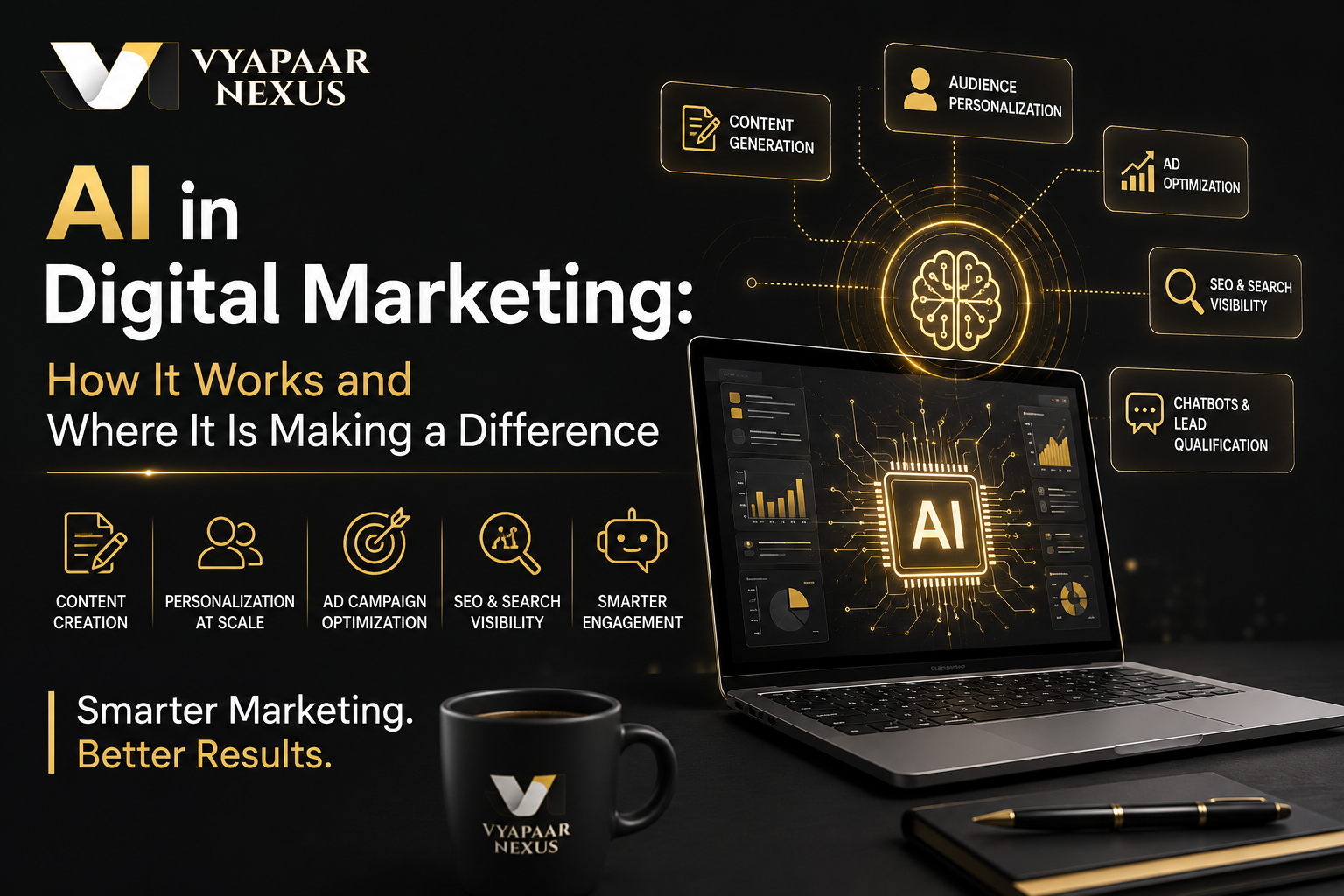
Where AI Is Making a Real Difference
1, Content Creation and Optimisation
Content creation is the most widely adopted AI use case in marketing. Across teams globally, 73% now actively use generative AI tools in their content workflow, applying them to blog outlines, social captions, email copy, ad variations, product descriptions, and content briefs. The businesses getting the strongest results treat AI as a production accelerator: AI compresses the time from brief to first draft, while human editing, fact-checking, and brand voice application happen before anything is published. Output volume increases without a corresponding increase in headcount.
2, Personalisation at Scale
Research from McKinsey shows 71% of consumers expect personalised interactions from brands, and 76% report frustration when that expectation is not met. AI enables personalisation at a scale that was previously feasible only for companies with large data infrastructure. It analyses browsing behaviour, purchase history, email engagement, and demographic signals to serve different messages to different segments automatically. AI-powered product recommendation engines account for up to 37% of total email revenue for e-commerce businesses, which illustrates the commercial impact of well-executed personalisation.
3, Paid Advertising Optimisation
AI has changed how paid campaigns are managed at both the platform and practitioner level. Google's Performance Max campaigns use machine learning to allocate budget across search, display, YouTube, and Gmail based on real-time performance signals. Meta's Advantage+ system automatically tests creative variations and audience combinations. According to industry data, 46% of advertisers currently use AI for bidding and mid-flight campaign optimisation. The practical outcome is more consistent performance with less time spent on manual adjustments.
4, SEO and Organic Search Visibility
AI is changing both how businesses optimise for search and how search itself operates. On the optimisation side, AI tools analyse content gaps, suggest semantic keyword clusters, and evaluate page relevance against search intent at scale. On the search side, Google's AI Overviews now appear at the top of results for many queries, summarising answers directly on the results page. Businesses optimising specifically for AI-cited and featured content see stronger organic visibility gains than those using traditional ranking approaches alone.
5, Customer Engagement and Lead Qualification
AI chatbots now handle 52% of customer interactions across businesses that have deployed them, with satisfaction scores reaching 84%. Beyond the support function, they capture leads, qualify prospects against pre-set criteria, and nurture website visitors outside business hours. The combination of consistent availability and structured qualification makes AI-powered chat a lead generation function rather than simply a cost-saving measure for support teams.
The Limitations of AI in Marketing
Despite the capabilities listed above, AI has clear limitations that matter in practice:
Getting Started With AI in Your Marketing
The most effective approach is identifying one specific workflow problem and solving it with one focused tool, rather than overhauling the entire marketing operation simultaneously. For most teams, the highest-time, lowest-strategic-judgment task is first-draft content creation. Starting there, running AI-generated drafts through a consistent human editing process, measuring the time saved per piece, and building from that foundation is a more sustainable integration path than attempting to implement AI across every function at once.
The businesses seeing the strongest results from AI in their digital marketing are using a focused set of tools consistently, with clear processes built around them, rather than experimenting with every new tool that launches.
Vyapaar Nexus builds digital marketing systems that combine AI tools with human strategy and editorial quality. If you want to understand how to integrate AI into your specific marketing goals and content workflow, get in touch and we will help you build the right process for your team and budget.