

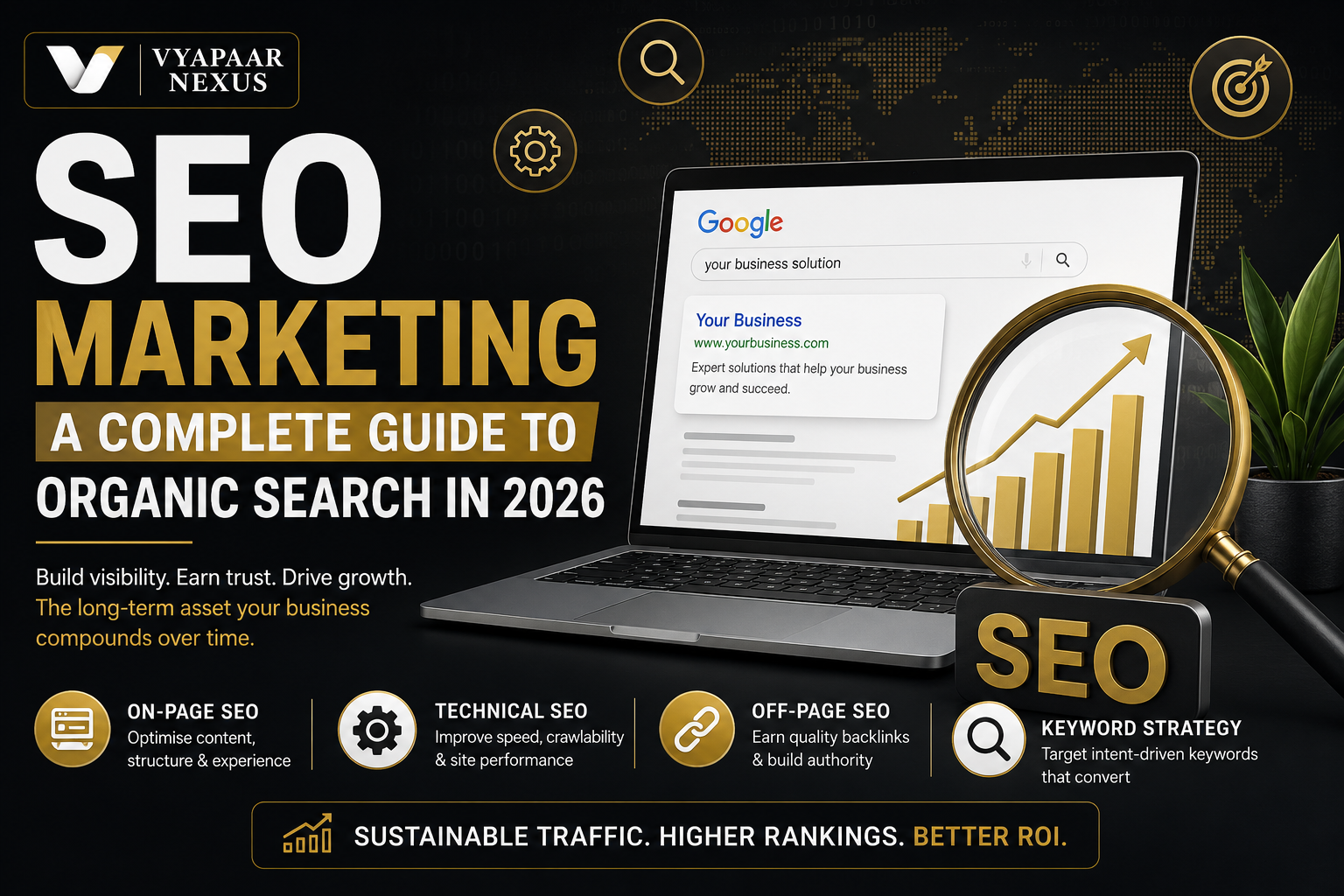
Every time someone types a query into Google, they are expressing intent. They want an answer, a product, a service, or a professional. SEO marketing is the discipline of positioning your business to appear at exactly that moment, through content and optimisation that demonstrates relevance and authority, rather than through a paid placement that charges for each click. The mechanism, the timeline, and the return on investment are all fundamentally different from paid advertising, which is why the two serve different strategic roles even when they share the same end goal of search visibility.
The scale of what organic search represents is worth understanding. Google processes 8.5 billion searches every day. Organic search drives 53% of all trackable website traffic, making it the single largest traffic source for most businesses globally. According to multiple industry studies, 49% of marketers say organic search delivers the best ROI of any marketing channel, a finding that holds consistently across multiple industry studies.
This blog covers how SEO marketing works, what the main components are, how long results take and why that timeline is worth committing to, and how to think about organic search as a long-term business asset rather than a campaign with a defined end date.
SEO Marketing: A Clear Definition
SEO marketing is the ongoing process of improving a website's visibility in organic, unpaid search results. It involves technical website health, content quality, keyword targeting, and the authority a website builds over time through links from other sites. These factors interact with Google's algorithm to determine where your pages rank when someone searches a relevant query. Among inbound marketers, 61% say improving SEO and growing organic presence is their top priority.
Unlike paid advertising, where visibility stops the moment a campaign is paused, SEO builds a compounding asset. Pages that rank well today continue generating qualified traffic months and years later. Every piece of well-optimised content you publish, every authoritative backlink you earn, and every technical improvement you make to your site contributes to a growing foundation that compound in value over time.
The Four Pillars of SEO Marketing
1, On-Page SEO
H1 Heading | Top of the page content | High — confirms page topic to Google |
|---|---|---|
URL Structure | Web address of the page | Medium — keyword in URL adds relevance |
Image Alt Text | Behind each image | Medium — helps image and page indexing |
Internal Links | Within body content | Medium — distributes authority across site |
Core Web Vitals | Site loading and interaction speed | High — direct Google ranking factor |
On-page SEO covers optimisations made directly on your website pages. The primary elements that influence organic rankings include:
2, Technical SEO
Technical SEO covers the infrastructure of your website: page loading speed, mobile responsiveness, crawlability, indexability, and structural integrity. Core Web Vitals, which measure loading performance, visual stability, and interactivity, are a direct Google ranking factor. A technically sound website is the foundation that every other SEO marketing effort depends on. Authoritative, well-optimised content sitting on a slow or poorly structured site consistently underperforms its potential in search rankings.
3, Off-Page SEO and Link Building
Off-page SEO centres on backlinks, which are links from other websites pointing to yours. Google treats backlinks as third-party signals of credibility. A site that has earned links from relevant, authoritative sources ranks higher than one that has not, assuming comparable content quality. Long-form content earns 77.2% more backlinks than short articles on average, which is why in-depth, thoroughly researched content builds domain authority more quickly over time.
A useful benchmark: 55.24% of all websites currently have zero backlinks. A modest, consistent link building effort puts any business ahead of the majority of its direct competition before any advanced tactics are needed.
4, Keyword Strategy and Semantic Search
Search engines rank individual pages, not websites as a whole. Each page needs to target a specific set of keywords and answer the search intent behind those queries better than competing pages do. Effective keyword strategy for SEO marketing involves identifying what your audience searches for, how competitive those terms are, and which combinations of primary and long-tail keywords represent realistic ranking opportunities for your site at its current domain authority level. Long-tail keywords of three or more words carry lower competition, stronger purchase intent, and are far more accessible for businesses building their organic presence from a lower starting point.
SEO Timelines: What to Expect and When
Meaningful organic rankings take three to six months to build from a new or under-optimised website. Highly competitive industries and broad, high-volume search terms take longer. Local markets and well-defined niche topics can move faster. This timeline reflects a genuine process: Google needs to crawl and index new content, assess its relevance against competing pages, evaluate the authority signals around your domain, and determine where the page deserves to rank.
The compounding nature of SEO is what makes the timeline worthwhile. A page that earns a strong ranking in month four continues generating traffic in month twelve and in month twenty-four without additional cost per visit attached to it. The businesses that start earliest gain the most from that compounding effect. Treating SEO as something to begin once you need organic traffic is the single most common and costly mistake in search marketing.
Local SEO vs General SEO
Local SEO follows the same foundational principles as broader SEO but places stronger emphasis on geographic relevance, Google Business Profile optimisation, and location-specific content. For businesses serving customers in a defined area, local SEO delivers some of the highest-intent traffic available in any marketing channel. Research shows 46% of all Google searches carry local intent, and searches with city-specific qualifiers or 'near me' phrasing indicate users who are close to a purchasing decision rather than still in the research phase.
Local SEO involves optimising your Google Business Profile, building location-specific pages and content across your site, earning local directory citations, and maintaining a consistent flow of genuine customer reviews. In many local markets, the competition for top organic positions is limited enough that a business investing consistently can establish a dominant local search presence within six to nine months.
Why SEO Is a Long-Term Business Asset
The right frame for SEO marketing is a business asset that appreciates over time, rather than a cost with a campaign end date. Unlike a Google Ads campaign that stops delivering results the moment the budget runs out, organic rankings continue driving traffic long after the work that produced them was completed. A well-optimised, authoritative blog post published today can generate qualified visitors for the next three to five years. Across dozens of well-ranked pages, that represents a substantial and growing return on content investment that compounds with every additional piece of quality content added to the site.
Vyapaar Nexus builds SEO marketing strategies that turn websites into consistent, growing sources of qualified organic traffic. From technical audits and keyword strategy through to content planning and link building, we manage the full search engine optimisation process. Reach out to understand where your site currently stands and what it will take to rank for the queries your customers are already making.